

The Real Reason Your Church's Tech Projects Keep Missing the Mark
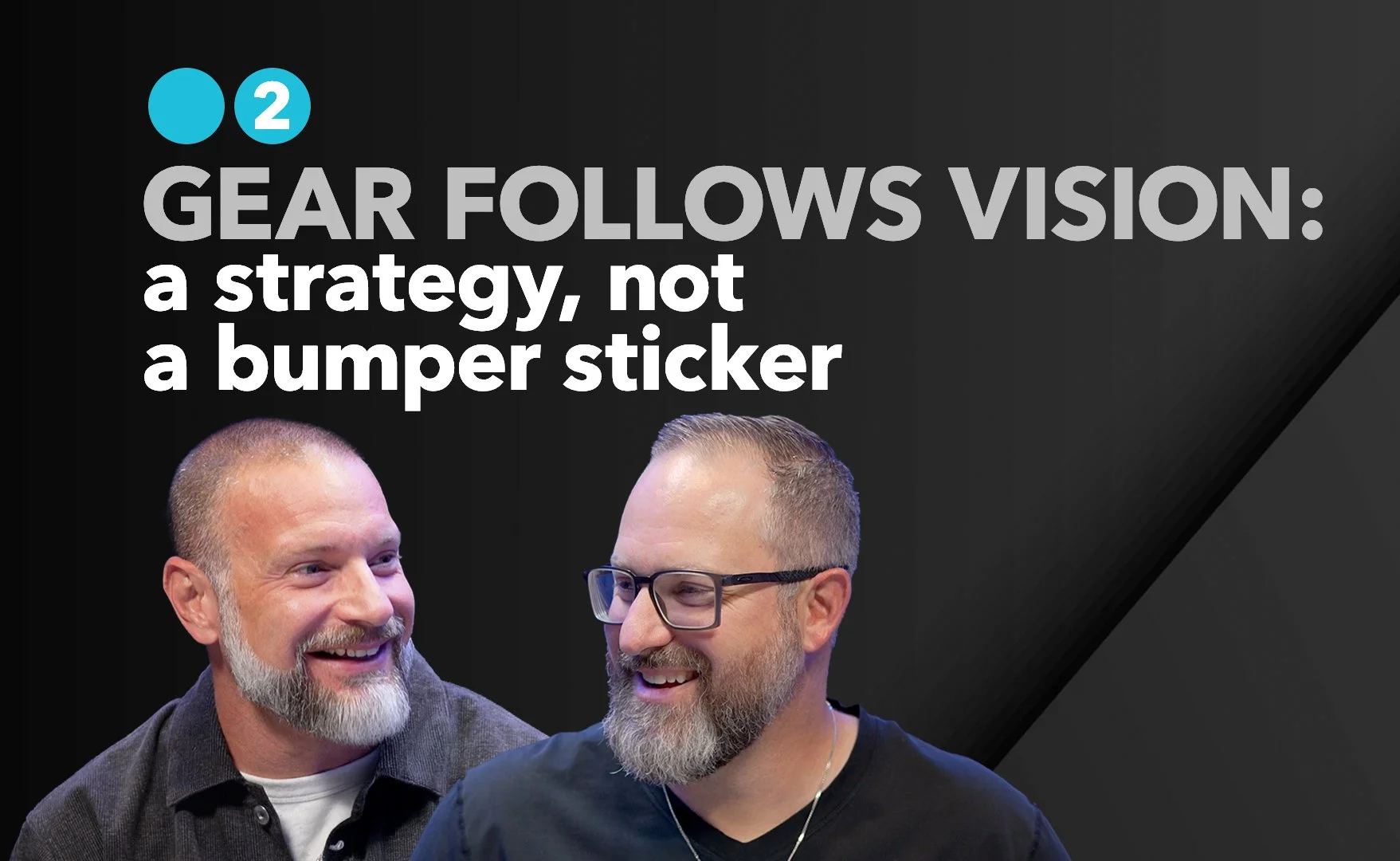
Let's talk about the elephant in the room. The one wearing a headset and standing at FOH.
Your church's production team is probably working harder than anyone realizes. They're the first ones in on Sunday morning and the last ones out. They're troubleshooting phantom power issues at 7 AM and explaining why you can't "just add another camera" for the third time this month.
But here's the thing we've learned after working with churches coast to coast: effort without alignment is just expensive noise.
And most churches? They're not aligned. Not really.
The Question Nobody Can Answer
Nick Kofahl, our co-CEO, has been in ministry long enough to know what questions reveal the gaps. As a pastor's kid, Bible college grad, and someone who's stood on both sides of the mic, he's seen what works — and what doesn't.
One question in particular? It cuts to the bone.
"We would start asking questions about vision," Nick says. "And most of them couldn't answer that question."
Not because they're lazy. Not because they don't care. But because nobody's ever asked them to articulate it.
So they default to tactics. Better mics. More lights. Shinier everything.
Meanwhile, the vision — the actual reason for all of it — remains fuzzy. Assumed. Unspoken.
And that's where the trouble starts.
What Happens When Vision Gets Skipped
Here's the pattern we see over and over:
A church decides it's time to upgrade. Leadership greenlights a budget. The production team starts researching gear. Vendors get called. Quotes roll in. Excitement builds.
Then reality hits.
The senior pastor wanted something intimate and stripped-down. The worship leader wanted something concert-ready. The elder board wanted something "like that megachurch we visited." And the production director? They're just trying to make everyone happy while keeping the thing under budget.
So what do you get? A compromise that makes nobody happy and serves no vision.
Nick's seen it happen enough to spot it from a mile away: "We really began to open up this dynamic... there's some things here that we really need to help get alignment with these folks, with the rest of their executive team or their executive leadership, so that we can help them be the most successful that they can possibly be when it comes to a technology solution."
Translation: if the leadership team isn't aligned, the gear can't save you.
Why "Good Enough" Is Actually Terrible
Let's level for a second. Most churches don't have unlimited budgets. You're not Flatirons. You're not Elevation. You're working with real constraints, real limitations, and a congregation that probably thinks the current setup is "fine."
But here's the rub: fine is the enemy of effective.
Because when you settle for "good enough" without knowing what "great" looks like for your specific context, you end up with tech that technically works but doesn't actually serve.
Nick tells a story that illustrates this perfectly.
Years ago, he toured Flatirons' 4,500-seat auditorium. Beautiful space. But some of the gear choices raised eyebrows. People wondered why they didn't go bigger. Why they didn't push the envelope.
Then Chris Coleman, the production director, took Nick to the lobby. On the wall were plaques representing missions organizations and ministry partners the church supported.
Coleman said: "Every dollar I didn't spend here goes here."
That's not settling. That's clarity.
That's knowing exactly what you value — and what you don't.
"Drop the mic and walk away," Nick recalls. "He goes, 'Yes, we could have done other things. Why? Because we had the money to do it. It was not a position of, oh, we don't have the money for it. We just have our values in the proper alignment.'"
The Three Questions That Change Everything
So how do you get there? How do you move from fuzzy to focused? From reactive to intentional?
Nick's distilled it down to three core questions. These aren't pretty. They're not easy. But they work.
1. Why Are We Doing This?
"We gotta start with why," Nick says. "Because if you don't have the why clearly nailed in the midst of those decision-making process, you don't have anything as your anchor point to go back to."
Not why in the abstract. Why specifically. Why now. Why this.
Are you trying to reach younger families? Create a more immersive worship experience? Support multisite streaming? Accommodate growth?
If you can't answer that in one sentence, you're not ready to buy anything.
2. Who Is This Really For?
This is where it gets uncomfortable.
"If the answer is the person that's being most impacted by this, is the dude standing behind the console, it's usually the wrong who," Nick says. "I'm sorry. You can be mad. Put it in the comments."
He's not wrong.
The best tech decisions serve the congregation, the message, the mission. Not the engineer's resume.
Nick shared a great example: "I just had this conversation the other day with another church. They were like, 'This whole section can't hear because the coverage is so bad.' Okay. Should probably point a speaker over there... Because we're limiting people hearing the gospel and being able to enter into a worship experience."
That's the right "who." The people in the seats who can't hear. Not the guy who wants to play with a new digital snake.
3. What Does Success Look Like?
Can you define it? Can everyone on the leadership team agree?
If not, you're flying blind.
"If we can start to get really, really clear about the why, about the who, and what does success look like, and we can all put our hands in the middle, man, we are in really, really good places," Nick explains. "That's probably 80% of the battle right there."
Eighty percent. Before you've touched a cable. Before you've spec'd a single piece of gear.
Start With a Conversation, Not a Catalog
We get it. This is harder than just buying gear.
It requires vulnerability. It requires patience. It requires production leaders to let go of some control and pastors to engage with details they'd rather delegate.
But the alternative? More projects that miss the mark. More budgets that get blown. More Sundays where the tech works but doesn't connect.
Nick's been at Summit for over 12 years now — longer than he's done anything else in his career. And in that time, he's learned one thing for certain: Gear follows vision. Not the other way around.
So before you call us (or anyone else), do the work. Have the hard conversations. Get aligned.
Because when you're clear on the vision? The gear practically picks itself.
And when Sunday morning comes? It just works. The way it should. The way it was always supposed to.
Need help getting started? We've got a Vision Blueprint with the exact questions Nick uses to help churches get aligned. No fluff, no filler — just the clarity you need before you spend a dime. Reach out, and we'll send it your way.
Because the best projects don't start with a purchase order. They start with a purpose. Our team has helped hundreds of churches find the sweet spot between their vision and their budget. We’d love to help.
If this sparked ideas, check out the full Gear Follows Vision episode here.