

Infrastructure Is the Decision You Can't Take Back
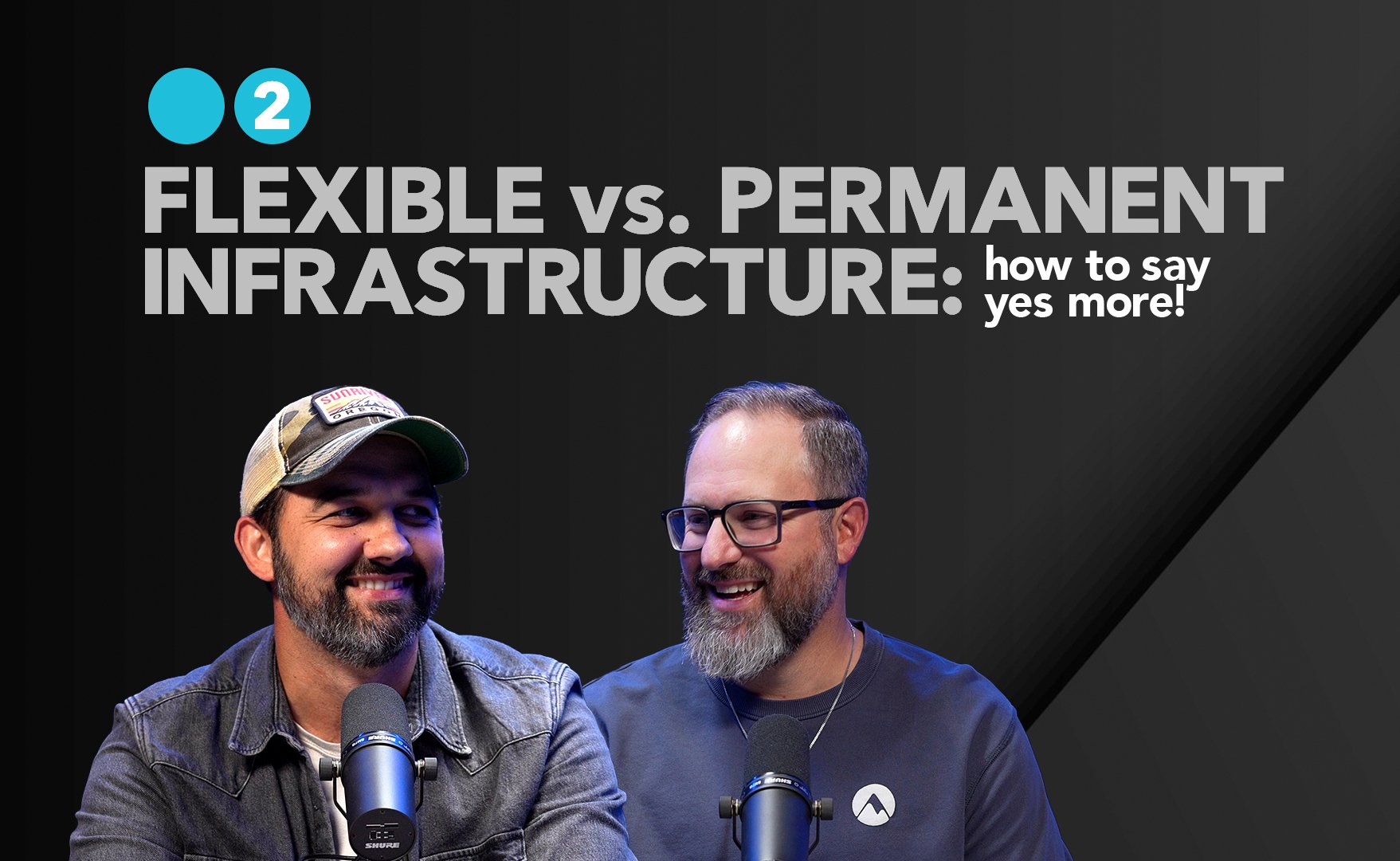
Weight. Power. Conduit. The unglamorous investments that determine what your church can do for the next fifty years.
There's a category of church technology decision that gets almost no attention in the conversations that matter — building committees, capital campaign planning, architect meetings — and enormous attention after the fact, when it's too late to change it without opening walls.
Infrastructure. Not the gear. Not the console or the cameras or the lighting fixtures. The stuff underneath all of that: the conduit runs, the structural load capacity, the electrical panels, the fiber pathways, the concrete pad under the building.
These decisions are boring to talk about. They're also the ones that determine what your church can actually do with its space for the next fifty years.
Jake Cody, our Account Manager here at Summit, spent seven years as Production Director at Bayside Church in Sacramento before joining our team. What he learned building one of the most flexible production environments in the country informs how we think about infrastructure on every project we touch.
The decision you actually have to make now
Here's a question worth asking at the start of any building project or major renovation: what do I actually have to decide today, and what can I decide later?
For production technology, the answer is almost everything can wait. Consoles can be swapped. Cameras can be upgraded. Fixtures can be replaced. New products come to market. Better solutions emerge. The gear decisions you make today will be different in five years regardless, so over-committing to them early is rarely wise.
What can't wait: the infrastructure that supports whatever gear you eventually choose.
"The only thing that was installed at Blue Oaks was a few 200-amp company switches, some ladder tray, and the superstructure to support the weight. Everything else is non-committal."
That's a radical application of the principle, but it illustrates the point well. Bayside committed to weight capacity and power. Everything else was left flexible. Five years later, they could reconfigure the room, change the PA, add a video system, and do none of it required opening walls.
Weight: the one you can't fake
Ceiling load capacity is perhaps the most irreversible infrastructure decision a church makes.
A PA that serves a 1,500-seat room weighs what it weighs. The structural steel that supports it either has the capacity or it doesn't. Rigging points that weren't engineered into the original structure can sometimes be added — at significant cost, with significant disruption, and with limitations that a purpose-built structure wouldn't have.
The conversation worth having with your structural engineer before a building is designed: what might we want to hang in this room? A touring-quality PA system for a 1,000-seat worship center can run 3,000 to 5,000 pounds. A full lighting rig with truss, motors, and fixtures adds more. Video walls and scenic elements add more still. If those loads aren't anticipated in the structural design, the options for achieving them later range from expensive to impossible.
And it's not just the auditorium. Multipurpose rooms, event spaces, lobbies that might someday host a stage — these all benefit from load capacity that was thought through before the concrete was poured.
"A client almost under-specced their concrete pad on a multimillion-dollar building. A $30,000 upgrade during construction saved them sixty to eighty years of headaches with forklifts."
Thirty thousand dollars at the design stage. The alternative would have compromised their operational flexibility for the life of the building. The math is easy. The conversation is easy. It just has to happen before the concrete is poured, not after.
Power: the infrastructure that unlocks everything
Modern production systems require serious power — and the flexibility to get that power where it needs to go.
Company switches (large-format power disconnects used in touring and live production) placed strategically throughout a facility are one of the highest-value investments a church can make in its production future. They provide the electrical capacity to power systems that haven't been invented yet, in locations that haven't been decided yet, without running new circuits through finished walls.
At Bayside's Blue Oaks campus, the power infrastructure was one of the few things permanently installed. Not because it was exciting. Because it unlocked everything else.
When the pastor wanted the stage in a different position, the power was there. When the room needed to flip orientation for a special event, the power was there. When a new PA system needed a different amp configuration, the power was there. The investment in power infrastructure wasn't about any specific system. It was about preserving optionality.
For churches in new construction, the conversation with your electrical engineer should include: where might we ever want to run a performance or event in this building? Every one of those locations is a candidate for a company switch. The cost of running additional circuits during construction is a fraction of what it costs to add them later.
Conduit: the pathway you'll always wish you had more of
Conduit is cable's infrastructure — the pathway through which signal, power, and data travel between spaces. Once walls are finished and floors are poured, adding conduit is invasive and expensive. During construction, it's relatively cheap.
The most common regret in production infrastructure isn't that too much conduit was installed. It's that not enough was.
The principle: wherever a signal might someday need to travel, a conduit pathway should exist. Stage to front of house. Control room to stage. Lobby to auditorium. Overflow space to main auditorium. Exterior locations for outdoor events. These pathways don't need to be filled immediately — empty conduit is fine. But the pathway needs to exist.
For churches evaluating a new build or major renovation, the conversation with your architect and electrical engineer should happen before the wall layout is finalized. Walking through the building with a production consultant at the design stage — when changes are still inexpensive — is one of the highest-value planning investments a church can make.
Network and fiber: the infrastructure of the next decade
Technology is evolving fast enough that format commitments made today have a real shelf life. The console that's industry-standard now may be surpassed in five years. The camera system that's cutting-edge today will be outdated in ten. Locking your building's infrastructure to any specific technology format creates a constraint that gets more expensive to resolve over time.
Network-based infrastructure — fiber runs, Ethernet pathways, IP-addressable systems — is as format-agnostic as infrastructure gets. Audio, video, lighting, control, communications — all of it is moving to network-based transport. A fiber backbone installed today will support systems that haven't been designed yet. A coax run for a specific SDI format is already a commitment to a technology trajectory.
"As you approach new projects, infrastructure is critically important. Not doing closed-loop systems. More fiber-based, network-based — because that's the way everything's going. Set yourself up so that five years, ten years down the road, when you inevitably do swap out your console, when you do swap out your camera — it doesn't matter."
The analog: when Apple finally standardized a charging port, plugging your phone into the car felt effortless. When they change it again, you want to throw the phone against the wall. Build your infrastructure so the next technology swap feels like the former, not the latter.
The multipurpose question nobody asks early enough
Every room in a church facility is a potential event space. Lobbies, fellowship halls, classrooms, outdoor plazas — all of them get used for things that weren't anticipated when the building was designed.
The production implications of multipurpose spaces are almost never considered at the design stage. Then a ministry wants to do a special event in the lobby, and there's no power, no signal pathway, and no way to hang anything from the ceiling.
The question worth embedding into every room's design process: if this space were ever used for a performance, a gathering, or an event, what would it need? Run power to that location. Run conduit. Spec the ceiling for at least minimal load capacity. The cost at design is small. The cost of retrofitting is large.
Bayside's culture of saying yes to almost anything — the firefighter's funeral, the Chamber of Commerce event, the last-minute pastoral idea — was made possible by infrastructure that anticipated use cases nobody had specifically planned for.
"We wanted to say yes more. So we invested in infrastructure. That was the sandbox. And as long as we were in the sandbox, we could do anything."
The conversation to have before the building is designed
The earlier in the building process a production infrastructure conversation happens, the less it costs and the more it accomplishes. A conversation at the design development stage — before wall layouts are finalized, before structural steel is specified, before electrical panels are sized — allows for decisions that cost almost nothing to make and would cost significantly to retrofit.
That conversation should include:
What are the expected uses of every space in the building, including secondary and tertiary uses?
Where might a stage, PA system, or lighting rig ever be positioned in this building?
What ceiling load capacities are needed to support those possibilities?
Where should electrical capacity be positioned to power production systems throughout the facility?
What conduit pathways are needed to connect control positions to stage positions in every space?
What network infrastructure — fiber, Ethernet, wireless access — supports the technology that will live in this building?
Most of these questions cost almost nothing to answer at the design stage. They cost a great deal to answer after construction is complete.
Infrastructure is the decision you can't take back. Make it well — early, deliberately, and with the next fifty years in mind.
Curious about the full convo? Check out the Gear Follows Vision episode here.
Got a project idea that’s stressing you out? Our team has helped hundreds of churches across the nation – if you have any questions you’d like a second opinion on, we’d love to help.